
By Lorena Mendoza Egúsquiza
Loreto.- The Shawi Nation has issued an urgent alert and public statement regarding the advance of settlers into part of its ancestral territory, a situation that has reportedly intensified in recent months following the announcement of the Balsapuerto–Moyobamba highway project promoted by the Regional Government of Loreto. The Indigenous government warns that the road threatens to open a new front of territorial conflict, mining activity, land trafficking, and environmental degradation in one of the best-preserved areas of the northern Peruvian Amazon.
In a statement released on May 27, the Board of Directors of the Autonomous Territorial Government of the Shawi Nation (GTA Shawi) reported that during the week of May 11, a “large group of invaders” entered the Cachiyacu River area, between the Pomayacu waterfalls and the salt mine located within Shawi ancestral territory, specifically near the communities of Canoa Puerto and Huituyacu.
For the Shawi people, the road project represents a direct threat to their headwaters, sacred sites, and strategic ecosystems, as the proposed route would cross territories that feed rivers such as the Paranapura, Cachiyacu, Yanayacu, Cahuapanas, and Sillay. These waterways are essential for community livelihoods and forest conservation.
“This road is generating land invasions and land trafficking,” the statement warns. The Shawi Nation rejects the regional government's proposal to approve an ordinance supposedly aimed at containing illegal occupations. In practice, they argue, the ordinance neither prevents nor will prevent the entry of settlers or illicit economies linked to illegal logging, wildlife trafficking, or mining. According to the Indigenous government, it is merely a declaratory measure with no effective enforcement mechanisms, and no concrete protection measures have been implemented to stop invasions and threats already affecting community territories.
The conflict also highlights a broader dispute over the future of connectivity in the Amazon. While the Regional Government promotes the highway corridor, the Shawi people argue that the road does not respond to their actual needs. They maintain that any improvements in connectivity should be evaluated based on technical and legal criteria and in accordance with the collective decisions of Indigenous communities, prioritizing river, air, or even rail transport alternatives rather than a highway.
Furthermore, GTA Shawi warns that the road would facilitate the expansion of mining activities in the territory. The statement points to mining concessions granted to FQM Perú S.A. and raises concerns about the potential growth of illegal mining operations, a scenario the Nation firmly rejects.
The Indigenous organization is demanding that the Regional Government of Loreto halt the road project within its ancestral territory, coordinate with Indigenous authorities to remove invaders, and comply with the standards of free, prior, and informed consultation and consent required for projects with significant impacts.
The warning comes amid a regional context in which numerous studies have documented how new Amazonian roads often become corridors for deforestation, informal settlement, and the expansion of extractive economies, disproportionately affecting Indigenous territories where state presence remains limited.“No decision concerning our territory should be made in our name and without our participation,”the Shawi Nation states. The organization insists that discussions about infrastructure cannot be separated from territorial rights or from the physical, cultural, and environmental survival of Indigenous nations in the Amazon.
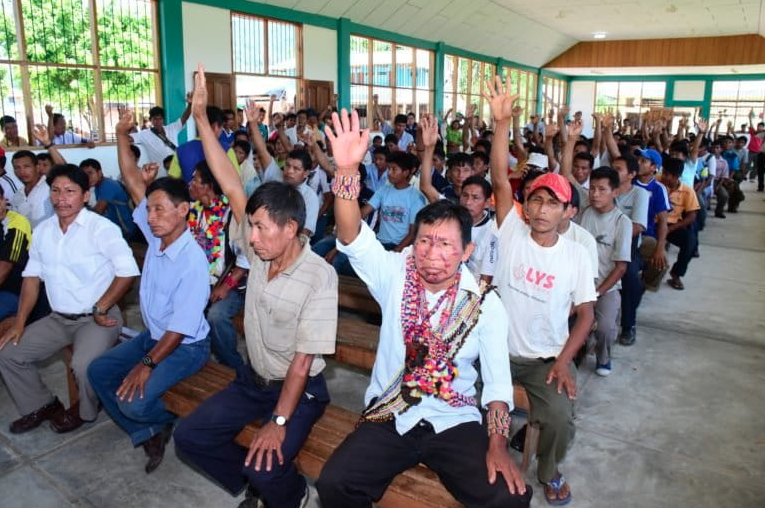
Photo: Mongabay / Nación Shawi