
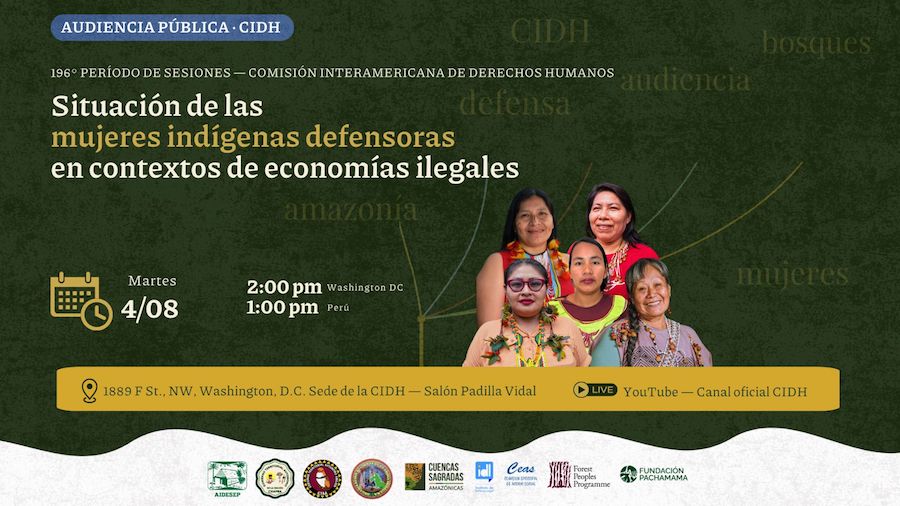
Lima, Peru.- On Tuesday, August 4, the Inter-American Commission on Human Rights (IACHR) will hold the thematic hearing “Peru: Situation of Indigenous Women Human Rights Defenders in the Context of Illegal Economies”as part of its 196th Period of Sessions. The hearing will address the risks and human rights violations faced by Indigenous women who defend their territories, collective rights, and livelihoods in the face of different forms of violence and illegal economies.
The hearing will take place in person at 2:00 p.m. (1:00 p.m. in Peru) in Washington, D.C., United States. Participants will include Teresita Antazú, Yanesha Indigenous leader and member of the Board of Directors of AIDESEP; Elaine Shajian, President of the Regional Coordinator of Indigenous Peoples of San Lorenzo (CORPI-SL); Matut Impi, Vice President of the Autonomous Territorial Government of the Awajún Nation; Olivia Bisa, President of the Chapra Nation; and Kelly Valencia, President of the Regional Organization of the Shipibo-Konibo Indigenous Guard (ORGI).
In Peru, human rights defenders face a context marked by the expansion and impacts of extractive activities, as well as the presence of illegal activities such as mining, logging, and land trafficking. These situations have fueled socio-environmental conflicts, as well as threats, attacks, and killings targeting those who denounce these activities and defend the rights of their communities. Amazonian women face particularly differentiated impacts, as they are often responsible for the care and protection of their families and communities in the face of socio-environmental consequences.
The IACHR hearing is a public forum resulting from a joint request submitted by the Interethnic Association for the Development of the Peruvian Rainforest (AIDESEP), the Amazon Sacred Headwaters Alliance, the Pachamama Foundation, the Episcopal Commission for Social Action (CEAS), the Forest Peoples Programme, and the Legal Defense Institute (IDL). The organizations seek to bring greater visibility to the challenges faced by Ashéninka women, with particular attention to the families affected by the Saweto case, as well as Shipibo-Konibo and Chapra women, in their roles as caregivers and defenders of their territories.
The hearing also comes at a particularly important moment for Peru. Over the past five years, the legislative branch has significantly weakened the country's human rights framework in favor of extractive economic policies. Now, as a new government administration begins, there is growing concern about the challenges facing the defense of Indigenous rights and territories. Bringing these voices before the IACHR is therefore an opportunity to draw attention to an issue that extends beyond Indigenous peoples and affects society as a whole.
The public will be able to watch the hearing live through the official YouTube channel of the Inter-American Commission on Human Rights and through the social media channels of the organizations convening the hearing. Standing with these women and amplifying their voices is also a way to defend our territories, our shared natural resources, and a democracy in which everyone can exercise their rights without fear.